I get asked about floaties constantly.
“Are floaties okay for my child?”
Whether it’s water wings, puddle jumpers, swim vests, or arm floaties, parents want to know the same thing:
Do these devices help keep children safe around water?
My answer is always the same, and it surprises people every time.
No.
But the answer is more nuanced than that. And here’s why.
Floaties Are Not a Layer of Protection
At Little Fins, we teach the Five Layers of Protection:
- Supervision
- Barriers and Alarms
- Water Competency
- Life Jackets
- Emergency Preparedness
Floaties and puddle jumpers are not considered one of the recognized layers of protection against drowning.
They are recreational devices, not safety devices.
That distinction matters.
The Problem with Floaties Isn’t What Most Parents Think
Most parents assume the risk with floaties is that a child could slip out of them, or that a cheap one might break. Those are real concerns. But they’re not the main issue.
The deeper problem is what floaties teach a child’s body to do in the water, and what they teach a child’s brain to believe.
When a child wears a puddle jumper or water wings, their body is held in a vertical position with legs hanging down. It feels stable. It feels safe. And that’s exactly the problem. That vertical, legs-down position is the position a drowning child is in. It’s not a safe resting position in water — it’s a position that requires constant effort to maintain, and it’s the opposite of what we actually teach children to do in a water emergency.
At Little Fins, we teach children something very different.
The Swim-Float-Swim method teaches children to roll onto their back, bring their legs up, and float horizontally. That’s a genuinely restful position. A child can breathe, recover, and orient themselves toward safety from there. Floaties train kids to stay vertical, which works against every instinct we’re trying to build.
The False Sense of Security Problem
Here’s the scenario I see play out more than I’d like.
A child spends an entire summer in a puddle jumper. They’re jumping off the step, splashing around, having a great time. They feel completely at home in the water. Their parents feel completely at ease. And then the floatie comes off, and that same child who looked so comfortable suddenly can’t manage even a few seconds in the water independently.
We call this “false confidence,” and it can be one of the most dangerous outcomes of floatie use.
Kids don’t know the floatie is doing the work. They think they’re doing the work. And when it’s gone, they’re genuinely confused, and genuinely at risk.
That false confidence is what makes floaties more dangerous than most parents realize. A child who is afraid of the water will stay close to the wall, hold a parent’s hand, and be cautious. A child who has been in a puddle jumper all summer thinks they can swim. Those two children are not equally safe at the edge of a backyard pool.
What We Teach Instead
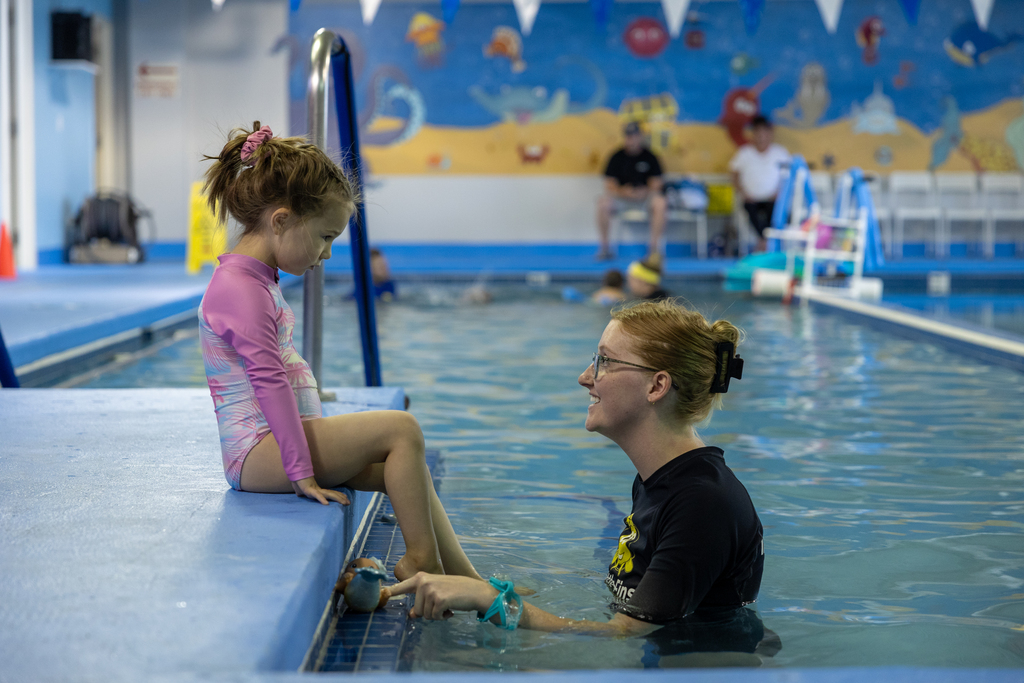
At Little Fins, we teach children what their body is actually capable of doing in water without any equipment at all.
For our youngest swimmers, that starts with Infant Survival Swim (ISS) lessons, where babies as young as six months begin learning breath control, rolling, and the foundational skills of the Swim-Float-Swim method. During 30-minute one-on-one sessions, our instructors work individually with each baby to build the muscle memory and water confidence that no floatie can replicate.
The sequence looks like this: a child enters the water, swims a short distance, rolls onto their back to float and rest, then rolls back over and continues swimming toward safety. That cycle can repeat until they reach the wall or an adult. It’s a genuine self-rescue skill, not a performance. And babies as young as six months can begin learning it.
For toddlers and older children, the same foundation applies. We build on it with stroke development, turns, and increasing distance, but the survival sequence is always the core. Before we teach a child to swim laps, we teach them what to do if they fall in.
Here in Colorado, many families spend time around pools, splash pads, reservoirs, lakes, and mountain vacations. Because water is part of so many family activities, we believe children deserve real skills that travel with them wherever they go.
“But What If They’re Just Playing at the Pool?”
I hear this one a lot, and it’s a fair question. Parents aren’t trying to teach their kids water survival every time they go to the neighborhood pool. Sometimes it really is just about having fun.
Here’s what I tell families: the goal isn’t to eliminate fun at the pool. It’s to make sure that fun is built on a real foundation. A child who has learned to roll and float doesn’t need a puddle jumper to feel safe in the water. They are safe, because they have an actual skill. And that skill goes with them everywhere — the neighborhood pool, a lake vacation, a backyard hot tub, a friend’s house.
A puddle jumper stays in your bag.
If you’re not sure where your child is in their water skills, that’s exactly what our Trial Assessment Lesson is for. It’s a focused 15-minute one-on-one session with one of our instructors. They assess where your child is, introduce them to how we work, and give you a clear picture of what comes next. No commitment required, just real information about where your child stands.
Schedule a Trial Assessment Lesson →
What About Swimming Lessons at the YMCA or Rec Center?
I always say this, and I mean it: all swim lessons are good swim lessons. If your child is in any program that gets them in the water and builds water familiarity, that matters.
But not all swim lessons are built around the same goal. A lot of group programs teach strokes and forward movement first. There’s a place for that. But a child who can do a freestyle stroke across a pool and a child who can roll, float, and find their way to safety are not the same child. The first child may be a stronger swimmer. The second child is a safer one.
Our 1-on-1 instruction means every lesson is built around your child specifically, their pace, their temperament, their current abilities, their goals. There’s no waiting for a turn, no instructor attention split between eight kids, no one-size-fits-all curriculum. Just 30 minutes of focused instruction tailored entirely to your child.
The goal at Little Fins has always been the same: kids who are genuinely safe around water, not just kids who look comfortable with equipment on.
If you’re ready to build real water skills, give us a call at (719) 344-5328 or book a Trial Assessment Lesson to get started. We’d love to meet your family.
Frequently Asked Questions
Are puddle jumpers safer than water wings?
Both create the same core problem: they hold children in a vertical position that doesn’t reflect how a safe swimmer actually moves through water, and they build a false sense of independence. We recommend neither as a substitute for real water skills.
My child is scared of the water. Won't floaties help them feel more comfortable?
Water comfort built on a floatie isn’t real water comfort — it’s the floatie’s comfort. The confidence we build in lessons comes from a child learning what their own body can do. That’s the kind of confidence that actually transfers to open water situations.
What age should my child start swim lessons if I want to skip floaties entirely?
We work with swimmers starting at six months old. The earlier a child builds genuine water skills, the longer they have that foundation before they encounter water without a parent beside them. Our Infant Survival Swim lessons start at six months, and our Aqua Babies parent-participation program welcomes newborns.
Are floaties safe for toddlers?
Floaties may help a child stay afloat while supervised, but they do not teach independent swimming or self-rescue skills. Many swim professionals recommend focusing on water competency and active supervision rather than relying on floatation devices.
Why do swim instructors dislike puddle jumpers?
Many swim instructors are concerned that puddle jumpers place children in a vertical position that can interfere with learning proper swimming and floating skills. They can also create false confidence around water.
What is better than floaties for toddlers?
The best alternative to floaties is developing real water competency through swim lessons. Learning to float, control breathing, and safely move through the water provides protection that doesn’t depend on equipment.
About the Author
 Lauri (Thomas) Armstrong is the founder and owner of Little Fins Swim School in Colorado Springs, Colorado. As a leader in Infant Survival Swim (ISS) education and drowning prevention advocacy, Lauri has helped thousands of families build life-saving water skills through early, research-informed instruction.
Under her leadership, Little Fins has become one of Colorado Springs’ premier destinations for one-on-one swim lessons, offering parent-and-me water introduction beginning at 2 months and structured safety and survival training starting at 6 months.
Lauri is passionate about replacing fear with confidence and believes water safety should begin before a child can walk — not after a close call. Her mission is simple: equip children with skills that could one day save their life.
Safety first. Skills for life. Awareness for the world.
➡️ Read more about Infant Survival Swim
➡️ Learn about our Colorado Springs swim lessons
➡️ Schedule a trial lesson